Miguel’s Story: Getting a Second Chance After a Life-Threatening Ruptured Aortic Aneurysm
What started as an ordinary day quickly became a life-threatening emergency for 44-year-old Miguel Corcino.
While watching TV, Miguel suddenly felt his jaw lock up. Thinking he just needed some fresh air, he stepped outside. "My mom took one look at me and said I looked really pale. Then my vision started going black," Miguel recalls.
Moments later, he lost consciousness.
Miguel was rushed to a local hospital before being transferred to Overlake Medical Center, where cardiothoracic surgeon David Nelson, MD, and the heart team specialize in treating complex cardiac emergencies.
Tests revealed Miguel had a nearly 10 cm aneurysm — a dangerous bulge in his aorta, the body's main artery that carries blood from the heart to the rest of the body. Doctors typically recommend repairing an aortic aneurysm when it reaches about 5.5 cm. Miguel's had grown to nearly twice that size. Even more concerning, blood was found surrounding the aneurysm, a sign that it had already ruptured but was temporarily contained by nearby tissue.
"It was hanging on by a thread,” Dr. Nelson recalls. “Usually, these ruptures are complete and the patient does not survive. Luckily, Miguel’s had been temporarily sealed but at any moment it could have ruptured completely. Time was of the essence."
Miguel underwent an emergency six-hour open-heart surgery to repair the damaged section of his aorta. After surgery, he spent several days recovering in the hospital, including time in the intensive care unit, where he relied on a breathing machine and around-the-clock monitoring while his body healed.
"I'm a stubborn guy so it was frustrating," Miguel says. "But I just kept pushing, so I could breathe and walk on my own."
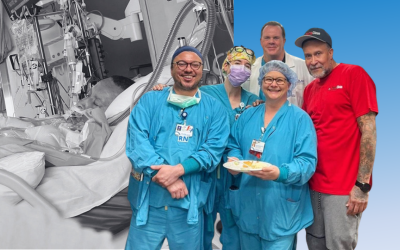
After returning home, Miguel came back to Overlake with lunch for the caregivers who saved his life. Seeing them again gave him a new appreciation for just how many people had been part of his recovery.
"The team was fantastic," Miguel says. "Coming back to see everyone, I realized just how many people had cared for me. I left feeling incredibly grateful."
Today, Miguel has a new perspective on life. "I don't take my life for granted anymore," he says. "The scar on my chest reminds me every day that I'm a survivor."
A silent but dangerous condition
An aortic aneurysm often causes few or no symptoms until it becomes life-threatening. If the weakened blood vessel tears, called an aortic dissection, it is a medical emergency that needs immediate treatment. Even more devastating, it can rupture — as Miguel’s did. Patients usually do not survive an open rupture.
“We were very fortunate with Miguel, as the temporary seal of the rupture gave enough time to get to the operating room. Unfortunately, many patients don't know they have an aneurysm until it becomes a catastrophic problem," Dr. Nelson says.
High blood pressure, certain inherited conditions and a family history of aneurysms can all increase the risk.
"It can happen to adults of all ages and come on very suddenly," Dr. Nelson warns. "You don't ever want to be in this situation. That's why knowing and controlling your blood pressure is so important, because sometimes that's the only visible warning sign."
Your heart deserves exceptional care
As the Eastside's most advanced heart and vascular program, Overlake Heart & Vascular Center provides comprehensive care — from prevention and early detection to advanced treatment and rehabilitation. When surgery is needed, our cardiothoracic team performs hundreds of minimally invasive procedures each year and offers the Eastside's only open-heart surgery program.
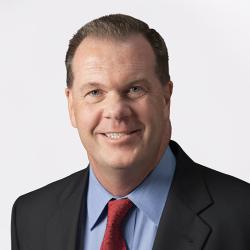
David Nelson, MD, is a board-certified cardiothoracic surgeon and Medical Director of Overlake Clinics Cardiothoracic Surgery.